Coordinate frames & poses
Glove hand and wrist frames, wrist_local skeleton poses, and XYZW quaternion conventions.
Coordinate frames & poses
To use a pose with a robot, camera, or renderer, read the component’s coordinate_frame and apply the calibrated transform to the target frame.
Data and coordinate frames
Read each raw hand or wrist component’s coordinate_frame. An algorithm package that outputs spatial poses defines their frame. Dynamic OpenXR uses wrist_local for its skeleton poses, and scalar joint values have no spatial frame.
Use this table to identify a field's frame. Raw-pose fields are members of GlovePose.payload.
| Data layer | Data stream / field | Coordinate frame |
|---|---|---|
| Raw pose | Physical glove hand.fingertips | device_hand |
External-input hand.fingertips | external_hand | |
wrist.position, wrist.quaternion_xyzw | device_wrist, in meters and XYZW. | |
| Algorithm output | HandSkeletonPose.positions_local, orientations_local_xyzw | wrist_local; all 25 nodes are expressed relative to the same wrist frame. |
HandJointCommand.joints | Scalar joint values; not a spatial coordinate frame. |
GloveImuPayload.imus preserves per-sensor raw counts or mdps/mg physical values. Check type and units first. The SDK labels caller-supplied hand input external_hand; supply numeric coordinates that meet the selected algorithm’s input requirements.
Coordinate frames
Data-source frames
Glove returns fingertips through payload.hand.fingertips and declares their frame in hand coordinate_frame. Optional payload.wrist has its own frame, timing, validity and freshness. Establish calibrated transforms to a robot, camera, Unity or ROS using those declarations.
GlovePose.meta.frame_id is optional source information. Each component declares its spatial reference through coordinate_frame. Hand and wrist update independently, so use timing and validity when deciding whether to combine them.
Device coordinate frame
VetraGlove Pro device poses use a right-handed Cartesian frame. The overview below places the three device forms in one view so their local axes can be compared directly.
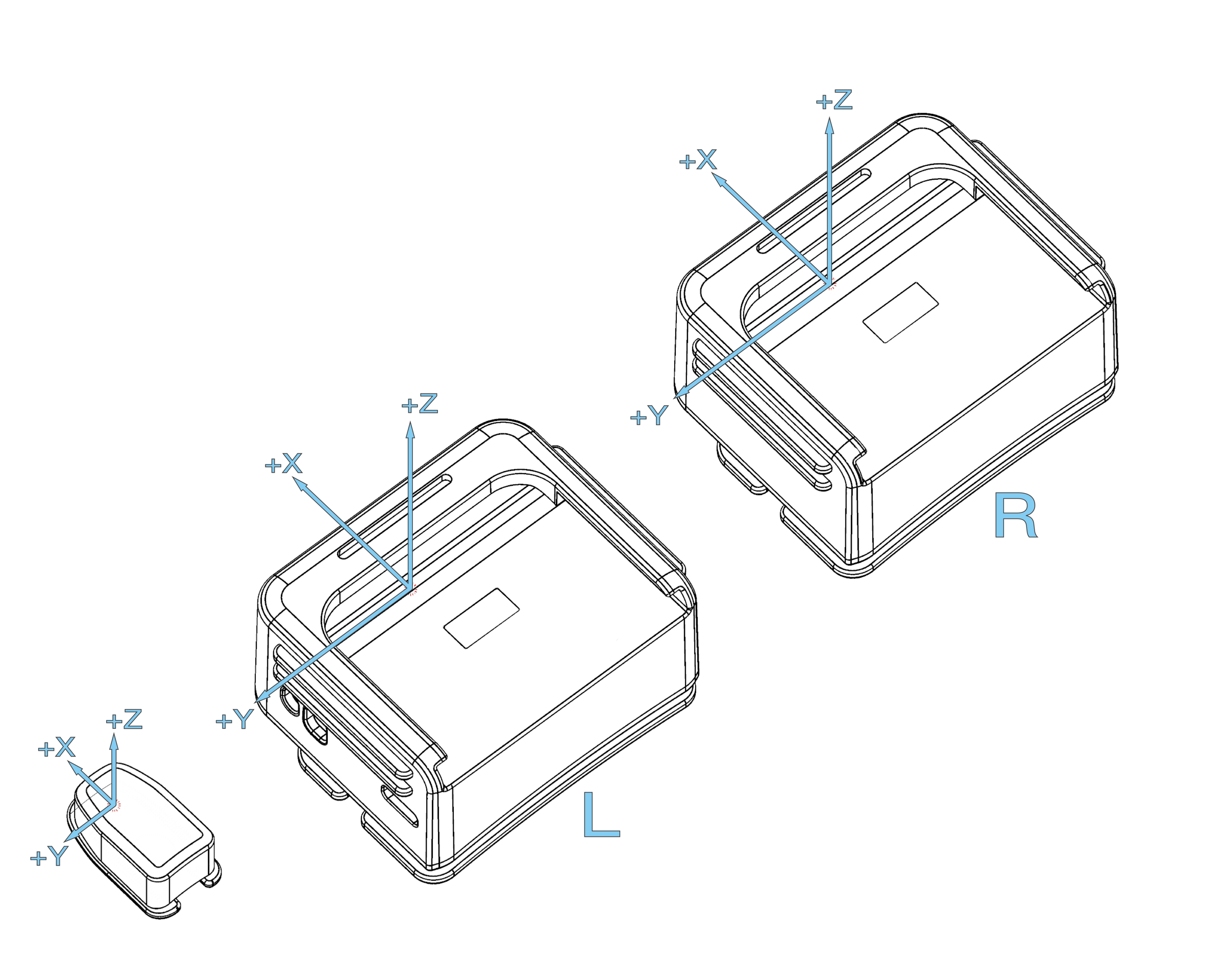
Each device's origin is located inside its enclosure and defined by nominal X, Y, and Z distances from three mutually perpendicular enclosure datum planes.
| Datum | Definition |
|---|---|
| Datum plane A | The enclosure end face on the device's -X side, perpendicular to the X axis |
| Datum plane B | The enclosure side face on the device's -Y side, perpendicular to the Y axis |
| Datum plane C | The enclosure bottom face on the device's -Z side, perpendicular to the Z axis |
| Device | Distance from A (X) | Distance from B (Y) | Distance from C (Z) |
|---|---|---|---|
| Fingertip sensor | 20.17 mm | 7.33 mm | 4.90 mm |
| Left-hand device L | 42.74 mm | 31.63 mm | 9.86 mm |
| Right-hand device R | 42.83 mm | 31.60 mm | 9.97 mm |
Each value is the perpendicular distance from the corresponding datum plane to coordinate-frame origin O, measured along the positive direction of the local axis, in millimetres. The left- and right-hand devices use their own local frames; identify each datum plane from the axes of the corresponding device.
Data component frames
Raw hand and skeleton data use different reference frames:
- Raw fingertip poses use
device_handfor physical gloves orexternal_handfor external input, notwrist_local. - Dynamic OpenXR skeleton poses:
HandSkeletonPoseuseswrist_local; all 25 nodes are expressed relative to the same wrist frame.
In wrist_local:
- the
wristposition is fixed at(0, 0, 0); - the
wristorientation is fixed at(0, 0, 0, 1); - the other 24 nodes are all expressed in the same wrist frame, not as parent-relative increments;
- this output contains no world pose.
wrist_local is an algorithm-output frame, not the EMF device frame; their relationship changes with the current wearer's calibration. The SDK applies that calibration automatically but does not expose the transform through its public API. Map raw fingertips by name and reference frame when correlating them with skeleton nodes.
See Retargeting and algorithm packages for the complete 25-node order.
Wrist pose and IMU
A glove with wrist tracking provides an independent pose through optional payload.wrist. Check presence, validity, freshness and timing before reading position in meters and XYZW quaternion_xyzw. Its coordinate_frame declares the reference frame.
To move or rotate the whole hand, convert the valid wrist pose to scene coordinates and apply it to the root of the hand model. If no usable wrist pose is available, use an external tracker for the root pose.
Coordinate transforms
Use a calibrated rigid transform from the component's declared frame to the application frame. For fingertips, frame corresponds to the hand component's coordinate_frame.
T_target_tip = T_target_frame · T_frame_tip
T_frame_tip  = inverse(T_target_frame) · T_target_tip
Confirm frame relationships, timing and validity before composing wrist and hand observations. ExternalGloveFrame positions use meters and quaternions use XYZW. The algorithm contract defines the input origin, axes and rotation reference, which stay consistent within one run.
Pose representation
- Positions are
(x, y, z)in metres. - All pose quaternions use
(x, y, z, w)(XYZW) component order, not WXYZ. - The identity rotation is
(0, 0, 0, 1). qand-qrepresent the same rotation; handle sign changes when building continuous curves or interpolating.- Use a rigid-transform library to change the rotation basis. Compose, invert, or interpolate quaternions in a shared frame.
- External input requires finite quaternions with a non-zero norm; the SDK normalises them before use.
Continue with Reading raw data, Retargeting and algorithm packages, and the API reference.